
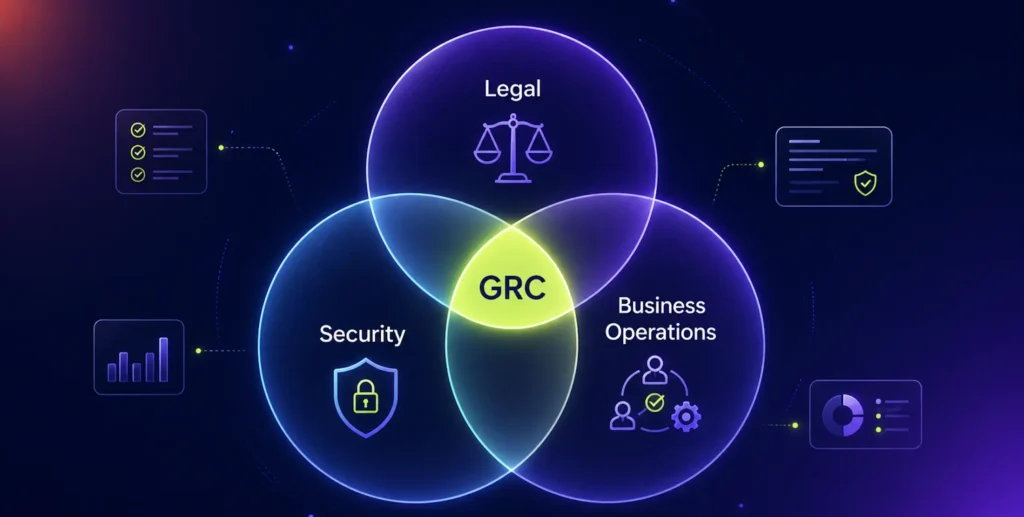

Who in the organization is responsible for keeping up with new regulations? Who turns those requirements into controls security teams can realistically implement? Oh, one more thing… as AI creates new risks and compliance obligations, who’s even looking at that? If you don’t have a clear answer for these questions, this may be a great opportunity to keep reading below.
This blog is based on an interview with Uriel Bekerman, an Argentine lawyer with over a decade of experience in GRC. Uriel holds a master’s degree in cyber security and is about to obtain his PhD in Information Systems at the University of Buenos Aires. Additionally, he holds several certifications, including ISO/IEC 27001 Lead Auditor, ISO/IEC 42001 Lead Implementer, and FIP, CIPM, and CIPP/E credentials from the International Association of Privacy Professionals (IAPP). Below, he shares his perspective on GRC and the evolution of AI regulations.
Dissecting the concept of G-R-C
GRC stands for Governance, Risk, and Compliance, but each letter represents an entirely separate domain:
- G = Governance: Know what you have, who owns it, and how security decisions are made across the company.
- R = Risk: Figure out what could go wrong, how likely it is, and how much damage it could cause.
- C = Compliance: Make sure the company meets laws, regulations, contracts, and standards such as ISO/IEC 27001, SOC 2, and PCI DSS, and can prove the right controls are in place.
Often, companies focus only on the “C” because they are required to pass audits, customer due diligence and third-party security questionnaires. As a result, leadership often measures the ROI of the GRC function by only looking at the most visible outputs, like policy documents, the business disaster recovery plan, guidelines, and the certifications the company obtained. However, a company can have all documents in check, pass an audit, and still have serious security gaps. In fact, there’s a term for this called compliance theater, which stems from the following:
- A policy can exist, and people may not follow it. The company may require MFA, access reviews, or logging, but those controls might still be poorly configured or inconsistently applied. In other words, the control was actually implemented, but there wasn’t anyone in the company reviewing it in detail to confirm that the implementation is really reducing the risk.
- Audits only look at a specific scope. Some systems, vendors, applications, or risks may fall outside the scope of the review. Audits are useful, of course, but they don’t guarantee anything.
- Compliance is usually a baseline. Meeting a standard does not automatically mean the company is protected against its biggest real-world threats.
- Everything is always changing after the audit. New employees, cloud resources, vendors, and configuration changes can quickly create new gaps. If the program doesn’t have a solid base, the constant movement makes it completely vulnerable.
- Attackers do not care about certifications. They look for whatever weakness they can exploit, even if it wasn’t part of the audit. Many CEOs ask themselves, how could I have this incident if I passed ISO/IEC 27001?
- Context matters. A small issue in one system may be a major risk in another if it handles sensitive data or supports a critical business process.
"GRC means governance, risk and compliance, but what leads this topic in the industry today is the C, for compliance. The point is that you can only achieve compliance properly if you have the G and the R in order. That is where many organizations fail."
Uriel Bekerman
The line between security and compliance is still blurry, but the direction is clear: security decisions now affect compliance, business risk, operations, and even financial exposure, so treating these functions separately no longer makes much sense. Uriel Bekerman’s career is a good example of that gap, since he became a lawyer and then decided to pursue a Master’s in Cybersecurity and a Ph.D in Information Systems. Having someone with this kind of hybrid background on the team is incredibly valuable because they can understand both the legal and security aspects of an organization:
“There was a gap in the market worldwide. The technical security side had no knowledge of the softer, legal side of the requirements coming from outside. And the lawyers had no technical knowledge at all. That is when I said, I have to get in here and work as a bridge between technical and non-technical teams. Actually, these days, only a few lawyers can fully address their own AI, privacy and cybersecurity concerns, even if we are talking about the legal side.”
Above all, there is one key reason why specialized security and compliance professionals are in very high demand…
Compliance is becoming a deal-breaker
Not being compliant can be a major cause of lost deals and, therefore, lost revenue. In many regulated industries like healthcare, finance, or telecommunications, customers expect vendors to meet specific security, privacy, and regulatory requirements before signing or renewing a contract. If a company cannot meet those requirements, the customer may delay the deal, choose another vendor, or terminate the contract. Some frameworks exist to enforce this point:
- FedRAMP 20x can determine whether a cloud vendor is eligible to sell to the U.S. federal government
- GDPR, LGPD, CCPA, HIPAA and PIPEDA, among other frameworks create privacy obligations for companies handling personal information
- The EU AI Act introduces new requirements for certain AI systems used in Europe.
All of the above-mentioned regulations in general can be partially or sometimes fully fulfilled with the implementation of international voluntary standards such as NIST CSF, ISO/IEC 27001, PCI DSS, CIS Controls, among others. While regulations say the “what”, standards help organizations with the “how”.
GRC teams also need to think about suppliers because regulated companies always pass security, privacy and compliance requirements down to their vendors, which is known as “the waterfall principle”. Still, making sure vendors are also compliant is a leading challenge for many companies. KPMG’s 2026 Global Third Party Risk Management Survey shows that only 18% of organizations were able to embed third-party risk successfully into their enterprise risk management program.
Ultimately, having more vendors to assess combined with new regulations creates a relentless need to hire more people, because the GRC workload keeps increasing. In fact, online forums are flooded with threads where people discuss this added pressure with questions such as “Is anyone else finding that compliance is becoming a second security job?” and “Anyone else drowning in security questionnaires?”. But, how does a GRC expert help relieve this pressure?
One of the goals of a GRC specialist is to avoid expensive fines
One of the main reasons companies hire GRC experts is to avoid extremely expensive fines. For example, under the General Data Protection Regulation (GDPR), Google was fined around $377 million in September 2025 for noncompliance with its cookie policy, which affected more than 74 million accounts. A few key lessons follow:
- Regulators want proof that companies are actually following the rules. A policy on paper is not enough. Companies need to show that consent, data access, privacy, and record-keeping are handled properly.
- Compliance needs to be built into systems and processes early. Trying to achieve compliance at a later stage usually requires structural changes in the organization, which is why practitioners say compliance is not the same as security and that many compliance problems are really design problems.
- Compliance doesn’t end at implementation… It begins there. You can comply with the law for 10 years, but if you are non-compliant for 1 minute, you failed, and if the authority knows it, you’ll be fined.
- Many companies still struggle to prove their controls work. Gartner found that most companies planned to review and audit compliance in 2026, but fewer than half were very confident they could actually prove their controls were working properly
Uriel summarizes the above into a great sentence: “If someone sends me the document, I say fine, that is a document, let us set it aside. Show me how you implemented it.” To implement controls effectively, we must not forget about the other two letters in the equation…
Governance (G) and Risk (R) are critical to achieve Compliance (C)
There is no company that can effectively reduce its risk, that doesn’t know all the business processes that it needs to maintain operatively, healthily and continuously. The knowledge about business processes must be the top priority for a GRC Lead, and after inventorying all of them, mapping who the owner of each is, and identifying and evaluating which are the most critical to ensure business continuity (the famous “BC”), the company must start with the identification of assets, internal/external people and
But this is the first part of Governance. When you already know what is most important for the organization, you actually haven’t started to think about what you need to do to keep it safe. That will be the last part of this long process. Secondly, our team always recommends to perform a regulatory scope analysis that includes includes not only identifying laws that apply the organization because of its industry and country where it operates, it also includes requirements that have been established in the contracts with its customers, employees, and, sometimes, market-expectations where you are a start-up company that doesn’t have any written agreement. In other words, a company that wants a future customer should be anticipated to its -very possible- requirement.
Last one, but of course not least important, is the risk (the R of GRC). When you have already passed the previous steps, you can -and only now- proceed with the risk identification process. For this, our team always uses ISO/IEC 31000 and ISO/IEC 27005 as our reference frameworks. When a company has already identified Process-Asset-People-Vendor, it can now assess by itself, “what could go wrong in this supply chain?”. This is what ISO calls an “asset-based” approach, because it starts by understanding what you have, and then thinking about which of those things you have may be compromised, stolen, or have other very bad consequences. Once you have identified the risks, at that moment you should start with the controls and requirements.
Why not before? Very easy – Because if you don’t know your assets, where will you apply those controls?, and this is the main gap that our team sees in the market today. Companies that have demonstrated compliance with many frameworks, but even if it was not intentional, they have reduced the scope of the audit, and they currently have a shadow risk in place.
How to properly govern AI
What happened in the last years with AI strengthened the idea that the GR can represent more importance and urgency than the C. The reason is that with the new and massive use of AI, entire companies, and their internal teams, started using AI freely and without any consideration about the purposes, the legal basis, the business processes that now depend on those systems, the contracts in place with customers -where sometimes they don’t allow the use of AI-, but mainly with a complete lack of knowledge about the risks that those AI systems may have or create.
With the new international AI standards, such as ISO/IEC 42001, NIST AI Risk Management Framework, and the EU AI Act, companies that already depend 100% on their AI systems, fully integrated into their internal and customer-face products and systems, needed to make a complete and retrospective review of the practices that the AI System had or didn’t have. Concepts such as “Human in/on the loop”, “AI Literacy”, “AI System Development Lifecycle”, among others and from the international standards, helped organizations to understand that they can’t depend on a non-governable third-party system without control. The risks that this brings are not only about governance (e.g., with AI hallucinating outputs, which is one of the most popular AI risks), but also about cybersecurity and privacy. Now every company that pursues an ISO/IEC 27001 certification should incorporate in their risk management process the identification of AI security risks, not treated as something that lives only in an AI framework. The same happens in privacy, where each data protection impact assessment under GDPR or ISO/IEC 27701 these days should incorporate an AI-scoped assessment to review potential illegal bases for processing or misalignment with the purposes consented by the data subject.
But, for what reason does this AI-migration strategy help enforce Governance and Risk teams to anticipate the Compliance? My opinion, is that there is no possibility to “control an AI system” if you don’t know perfectly the processes where you are using it, from what vendor, who reviews and if it is in or on the loop, with what frequency, who provided the databases, who trained the model, and who tested it, among other aspects. The point is that cybersecurity standards like those mentioned before are mainly technical and apply primarily to technical teams. This doesn’t happen at the same level in AI Governance. Right now, AI standards focus more on the knowledge of the company about all the supply chain and governance models, rather than about technical risks that you need to reduce with controls. If you check the Annex A from ISO/IEC 42001, you will see more than a half of controls about documentation.
So, can ISO/IEC 42001 help GRC to re-priotize the next efforts to organize a company about its risks and controls? Our team hopes so.
AI is changing who you need to hire
As mentioned, for years, cybersecurity hiring focused heavily on technical execution. Companies looked for engineers who could secure cloud environments, configure tools, and manage infrastructure. AI is starting to change that balance. As more execution gets automated, companies increasingly need people who can decide what to delegate to AI. This is precisely where a GRC expert can add value, helping the board and the CISO map out how AI is being used, classify risk, define governance requirements, and translate them into controls.
In fact, all major firms are pointing in the same direction: governance matters more than technology. To prove this point, Deloitte’s State of AI in the Enterprise found that only one in five companies has a mature governance model for autonomous AI agents.
The lack of AI governance leads into two hiring needs. First, companies need people who can govern AI inside products and business processes, including human oversight, bias, data access, vendor risk, and accountability. Frameworks such as ISO/IEC 42001 and the NIST AI Risk Management Framework are already giving organizations a structure for that work.
Second, the problem of AI security risks, where companies need people who can control how employees use AI internally. Employees are already pasting code, customer information, contracts, and other sensitive data into tools like ChatGPT, Claude, Copilot, and Gemini. Gartner’s cybersecurity trends for 2026 show how widespread that behavior has become. But, in parallel, companies shouldn’t just block the use of AI because it can promote the AI shadow risk, so the solution should be with governance, risk and control management processes.
So, AI is changing the profile companies need to hire, and that opens up a great opportunity to leverage security and compliance talent from places like Latin America, where you can find certified, bilingual professionals at much more competitive hourly rates.
Choosing a nearshore GRC vendor saves you a lot of $$
When looking to implement controls across the organization, the biggest barrier is always cost. Uriel puts it very clearly:
“I was recently sent a quote from a privacy lawyer. How much per hour? Five hundred dollars ($500/hr). And he did not have the certifications I have. And you don't need one hour; you need many hours. It is so expensive in the United States that some organizations like small startups would rather ignore compliance. In Latin America, you can find much better talent for less.”
Uriel Bekerman
Based on our own experience, a specialized provider from Latin America can offer compliance services at approximately 30-60% lower cost compared to a local firm in the USA.
Setting costs aside, our clients usually have a big concern when hiring GRC consultants outside of the United States: if regulations are local, does it really make sense to hire a GRC specialist in a nearshore model? The answer is that nowadays, location doesn’t matter because the underlying frameworks are global.
For example, ISO and NIST are the same in Buenos Aires as in Boston, and much of the work is the same: understanding risk, mapping requirements, defining controls, preparing for audits, managing vendors, and collecting evidence that the controls are working.
Another important point is that GRC does not stop after passing an audit. Regulations change, customers send new security and privacy questionnaires, vendors introduce new risks, and AI creates new governance requirements. So, companies need to embed someone who can keep the program moving, and paying for recurring billable hours requires a significant investment over time, so any opportunity to save costs is valuable.
Often times, the organization may require ongoing hours from an entire security team! Thus, another major advantage of working with an external vendor is being able to tap into an entire security and compliance engineering team on demand, gaining access to critical roles such as:
- Fractional CISO to define security strategy, priorities, budget, and board-level reporting
- GRC analyst to interpret regulations, manage risk, prepare for audits, evaluate vendors, and define the controls the company needs
- Application security (AppSec) engineer to implement those requirements inside the software development process and produce the technical evidence auditors and customers will eventually ask for
As AI enables smaller teams to build and release software faster, having these roles working together becomes even more important. Security, privacy, and governance requirements need to stay close to engineering so they can be addressed while the product is being built, rather than after a customer, auditor, or regulator raises a concern.
Considering everything we’ve covered, we hope that you take away the main idea: building a strong GRC program requires working with subject matter experts. If you are looking to onboard a GRC analyst, Ewents can provide senior, certified analysts at ultra-competitive rates, working remotely from Argentina. Reach out to our team to build your GRC function from scratch or strengthen your existing program.
Frequently Asked Questions (FAQ)
What is GRC in cybersecurity?
GRC stands for Governance, Risk, and Compliance, and it is a core pillar of having a mature cybersecurity program.
A common mistake is to think that cybersecurity is mainly about implementing as many controls and security tools as possible. However, controls applied without a clear understanding of the business, its critical processes, and its actual risks can create a false sense of security. For example, a company may have endpoint protection, vulnerability scanners, encryption, access controls, and multiple certifications. Yet, if nobody has clearly identified which systems are critical, what data matters most, who owns each risk, and what the business impact of a failure would be, the organization may still be poorly protected. The controls should be the way that a company “mitigates the risk they previously identified”, and they shouldn’t be the only focus of GRC. If a company doesn’t identify and evaluate the risks under a recognized framework, the controls, even if they were taken from ISO, NIST, PCI or CIS, will be easily vulnerable.
At a high level, GRC connects three areas:
- Governance defines how cybersecurity decisions are made, who is accountable, and how the security program supports business objectives.
- Risk Management identifies what could negatively affect the organization, evaluates likelihood and impact, and helps leadership decide what should be addressed first.
- Compliance ensures that the organization meets relevant laws, regulations, contractual obligations, and security standards, mitigating the risks with the best controls as possible.
Additionally, understanding why a security control exists is just as important as implementing it. A company should not encrypt data simply because ISO 27001 or a customer questionnaire requires encryption. It should understand what data is being protected, what could happen if that data were exposed, and whether encryption meaningfully reduces that risk. In other words, first the governance and risk, second the control that reduces it.
Many companies today are relatively mature in compliance, the “C” in GRC. They may hold ISO/IEC 27001 certifications, pass SOC 2 audits, and complete customer security questionnaires.
However, compliance does not automatically mean strong governance or effective risk management. Of course it helps, but an organization can satisfy many control requirements and still misunderstand its most important business risks.
When does a company need a cybersecurity GRC function?
Every organization should have some form of GRC function.
The level of formality will naturally depend on the company’s size, industry, regulatory environment, and risk profile. However, even smaller organizations need to understand risk, establish accountability, and govern cybersecurity.
A common mistake is waiting until a customer, regulator, investor, or government authority asks for a formal security program. By then, the organization is usually reacting under pressure. Moreover, mature GRC programs take time to build because they involve much more than writing a few policies or preparing evidence for an audit.
A proper GRC function helps the organization understand which business processes are critical, which systems and data support those processes, what cybersecurity risks could disrupt them, who owns those risks, and which controls are actually reducing them.
Additionally, companies should not build GRC solely because they expect a future audit or certification. The primary objective should be to govern the cybersecurity program effectively and reduce business risk.
Compliance with standards such as ISO/IEC 27001, SOC 2, PCI DSS, HIPAA, or other requirements should then become a natural consequence of having a well-managed security program.
In other words, the company should first understand its risks and build the right controls around them. Once that foundation exists, compliance becomes much easier to demonstrate.
Can IT teams handle governance, risk, and compliance on their own?
Developers and technical teams play an essential role in cybersecurity, but they generally cannot operate a complete GRC program on their own.
In my experience, mature GRC programs require professionals who understand not only technology, but also risk management, auditing, business continuity, regulation, cybersecurity standards, privacy, and increasingly AI governance.
GRC also requires a different type of thinking than traditional software engineering.
A developer may know how to configure GitHub or GitLab securely, enable multi-factor authentication, implement encryption, run security testing, configure cloud controls, or collect technical evidence for an audit. Those skills are extremely valuable, but they represent only one part of a broader GRC program.
A GRC professional also needs to understand how a technical weakness translates into business risk. For example, discovering that a system does not have MFA enabled is a technical finding. The broader GRC questions are: Who has access to that system? What information does it contain? What would happen if an account were compromised? How likely is that scenario? What could the financial, operational, regulatory, or reputational impact be? Following this example, the main problem is that many organizations review this control implemented in the most critical asset, and mark it as check when they can have a coverage risk because many other assets don’t have the control well implemented. The questions should be part of a fixed and previously scheduled risk assessment, that not only review the existence of the control but also its capacity, coverage and reliability, overall, its maturity.
Moreover, GRC requires visibility into the organization beyond IT. A mature program may involve Human Resources, Legal, Finance, Operations, Procurement, Engineering, Executive Leadership, and third-party vendors.
For example, developers are unlikely to monitor whether every new employee has completed security training, signed the required agreements, received the correct level of access, and had that access removed when they leave the organization.
Secondly, GRC depends heavily on communication. Professionals need to translate technical issues into language that executives, auditors, lawyers, customers, and regulators can understand.
Finally, frameworks such as ISO 31000 and ISO/IEC 27005 require structured approaches to evaluating and managing risk that go far beyond implementing technical controls.
Technical teams should therefore be deeply involved in GRC, but they should work alongside professionals who understand governance, risk, audit, and compliance.
What is AI GRC, and when does a company need it?
AI GRC applies governance, risk management, and compliance principles to the use, development, training and deployment of artificial intelligence systems.
AI has boosted the importance of GRC because organizations are adopting AI systems quickly, often without fully understanding how those systems are used, what data they process, who is responsible for them, or what risks they introduce.
Additionally, AI governance is much broader than AI cybersecurity.
For example, ISO/IEC 42001 focuses on establishing an Artificial Intelligence Management System. It helps organizations create structured processes for governing how AI is developed, deployed, monitored, and used.
A mature AI governance program should be able to answer questions such as:
- Where is AI currently being used across the organization?
- What business purpose does each AI system serve?
- What data does the system use, and where does that data come from?
- Who owns the AI system and who is responsible for reviewing its outputs?
- Can the system make decisions autonomously?
- Could it introduce bias, discrimination, privacy issues, or other unintended consequences?
- What third-party AI providers are involved?
- How is human oversight maintained?
Moreover, companies do not need to be developing their own AI models before AI GRC becomes relevant. An organization may already need AI governance because employees use tools such as ChatGPT, Claude, Copilot, or other AI systems with company information.
The level of governance should increase with the level of risk. Using AI to summarize an internal meeting creates a very different risk profile from using AI to approve loans, make hiring recommendations, analyze patient information, or influence decisions that directly affect customers.
This is why AI has brought GRC back to the center of the conversation. Before implementing controls, organizations need to understand what AI systems they use, why they use them, what information those systems process, and what risks they create.
Why should I enforce enterprise AI governance across my organization?
Enterprise AI governance helps an organization understand where AI is being developed, used, what it is being used for, what are the legal requirements in-scope and what risks it creates before those risks become difficult to control.
As AI adoption expands, different departments may begin using AI tools independently for tasks such as summarizing meetings, analyzing documents, writing code, processing customer information, or supporting business decisions. Without a common governance framework, the organization can quickly lose visibility into which AI systems are being used, what data is being shared with them, and who is responsible for their outputs.
Additionally, not every AI use case creates the same level of risk. Using AI to summarize an internal meeting is very different from using AI to analyze sensitive customer data, support hiring decisions, interact with patients, or power a customer-facing product. Enterprise AI governance gives the organization a consistent way to evaluate those use cases based on their actual risk.
Moreover, enterprise AI governance helps prevent every department from creating its own rules. Instead of Legal, Security, IT, HR, and business teams evaluating AI independently, the organization can establish common policies, approval processes, responsibilities, and risk criteria.
This becomes even more important as AI systems become more deeply integrated into business operations. Once AI is connected to internal data, APIs, customer-facing products, or automated workflows, removing or changing those systems can become significantly more difficult.
For that reason, companies should not treat AI governance as something they add only after AI adoption becomes large or regulated. It should grow alongside the organization’s use of AI and applying security and privacy-by-design principles.
Ultimately, enterprise AI governance gives the company visibility and control. Before an organization can protect an AI system, monitor it, or demonstrate compliance, it first needs to understand what the system does, why it exists, what it depends on, and what could go wrong.
Can a GRC cybersecurity analyst help our organization reduce risk?
Cybersecurity risk is ultimately business risk. A vulnerability, data breach, system outage, failed audit, regulatory violation, or compromised third party matters because of the impact it can have on the organization.
That impact may include lost revenue, operational downtime, regulatory penalties, legal expenses, customer loss, reputational damage, loss of intellectual property, or disruption of critical business operations.
This is why I often say that GRC programs should not be designed simply to solve cybersecurity problems. They should help organizations protect their ability to achieve business objectives. This makes a company more mature, not only improving the security team.
For example, a company can obtain ISO 27001 certification and still suffer a major cybersecurity incident. The certification demonstrates that the organization has established and maintains an information security management system, but it does not guarantee that every possible business risk has been eliminated.
Moreover, completing a checklist of 30, 50, 70, or 100 controls does not automatically mean that an organization understands every significant risk it faces.
A mature GRC analyst should help leadership understand which risks could cause the greatest damage, which risks are most likely to occur, which systems are critical to revenue or operations, where security budget should be allocated, and which risks the organization is willing to accept.
What GRC analyst skills belong in a job description?
A strong GRC analyst needs to understand both the technical and business sides of cybersecurity. The role does not require being the deepest technical expert in every area, but it does require enough knowledge to understand what security teams are doing, why it matters, and how it affects the business. Some of the key requirements include:
- International standards and frameworks: A key requirement is strong knowledge of cybersecurity frameworks such as NIST CSF, ISO 27001, SOC 2, PCI DSS, and CIS Controls, and privacy regulations such as GDPR, LGPD, HIPAA, CCPA, among others. It is also important to understand how these frameworks overlap, since most companies are dealing with several requirements at the same time. You may implement one control and comply with 5 regulations. This is called “crosswalk mapping” and a very good understanding of international frameworks allow an organization to rationalize and deduplicate efforts.
- Risk management: Another key requirement is the ability to translate technical issues into business risk, basing the approach in international risk management frameworks such as ISO 31000, ISO/IEC 27005 or NIST SP 800-37. An outdated server, for example, only becomes meaningful once the analyst understands what it supports, what data it contains, who can access it, and what the impact of a compromise could be.
- Regulations and audits: GRC analysts need to understand the regulations that apply to the organization and how those requirements translate into actual controls. Sometimes cybersecurity requirements are found in regulated-industry regulations (e.g., a banking law) and the specialist should be capable of reading and understanding all the applicable requirements for the organization. Audit experience is also valuable because it helps the analyst understand what evidence is expected and how to prove that controls are working.
- Technical cybersecurity knowledge: A key requirement is enough technical depth to work closely with security and engineering teams across areas such as IAM, cloud security, vulnerability management, encryption, incident response, business continuity, and disaster recovery.
- Communication: GRC also requires strong communication skills. Analysts constantly translate between engineers, executives, lawyers, auditors, customers, and regulators, so they need to know what each audience needs to understand and how much technical detail is appropriate.
Certifications can also be valuable because GRC is closely tied to recognized standards, audit methodologies, and risk frameworks. However, they matter most when combined with hands-on experience applying those requirements inside a real business.
What are the advantages of hiring a nearshore GRC company?
Hiring a nearshore GRC vendor can give your organization access to more specialized security and compliance expertise without limiting the search to one local market. A few benefits include:
- Access to a wider talent pool: Strong GRC professionals are hard to find because the role requires experience across cybersecurity, risk management, audits, regulations, privacy, cloud environments, and multiple compliance frameworks. Nearshore hiring opens the search to experienced professionals across Latin America.
- Lower rates for senior expertise: Nearshore security and compliance professionals can often provide similar levels of experience at approximately 30% to 60% lower rates than specialized U.S. consulting firms.
- International certifications and experience: Nearshore professionals may already hold certifications such as ISO/IEC 27001,ISO/IEC 42001, CIPP/E, CIPM, CISSP, or other recognized credentials, while also having experience with U.S. companies, global audits, and regulated industries.
- U.S. time-zone overlap: Teams across Latin America can usually work directly with North American security, engineering, legal, and executive teams during normal business hours. That also makes it easier to participate in audits, customer calls, vendor reviews, and security meetings.
- A fresh outside perspective: External GRC professionals can identify outdated controls, inefficient processes, or risk assumptions that internal teams may have simply become used to over time.
- Ability to build a broader security team: Working with an outsourced team that can provide the talent on demand makes it easier to combine GRC expertise with roles such as a fractional CISO, AppSec engineer, cloud security engineer, or privacy specialist without hiring every role locally.
How will GRC evolve into AI governance and risk management?
As companies deploy more AI across their operations, GRC teams will need to govern not only systems and data, but also how AI models are used, what decisions they can make, and which risks they introduce.
In tandem, AI will automate many of the operational tasks GRC teams handle today, such as:
- Collecting compliance evidence and preparing audit documentation.
- Mapping controls across regulations, frameworks, and internal policies.
- Monitoring systems and configurations for compliance gaps or policy violations.
- Reviewing environments continuously instead of relying primarily on periodic assessments.
- Identifying potential risks and escalating issues that require human review.
Ultimately, GRC will become more focused on governing increasingly automated organizations, with thousands or even millions of agents running across every area. Consequently, GRC professionals will spend more time understanding business and AI risk, defining accountability, setting policies and guardrails, and making sure AI adoption remains secure, compliant, and aligned with the organization’s risk tolerance.